

New U.S. Section 301 Tariffs Are Live: What Shippers and Importers Need to Know
Jul 28, 2026
Leave a message
New U.S. Section 301 Tariffs Are Live: What Shippers and Importers Need to Know
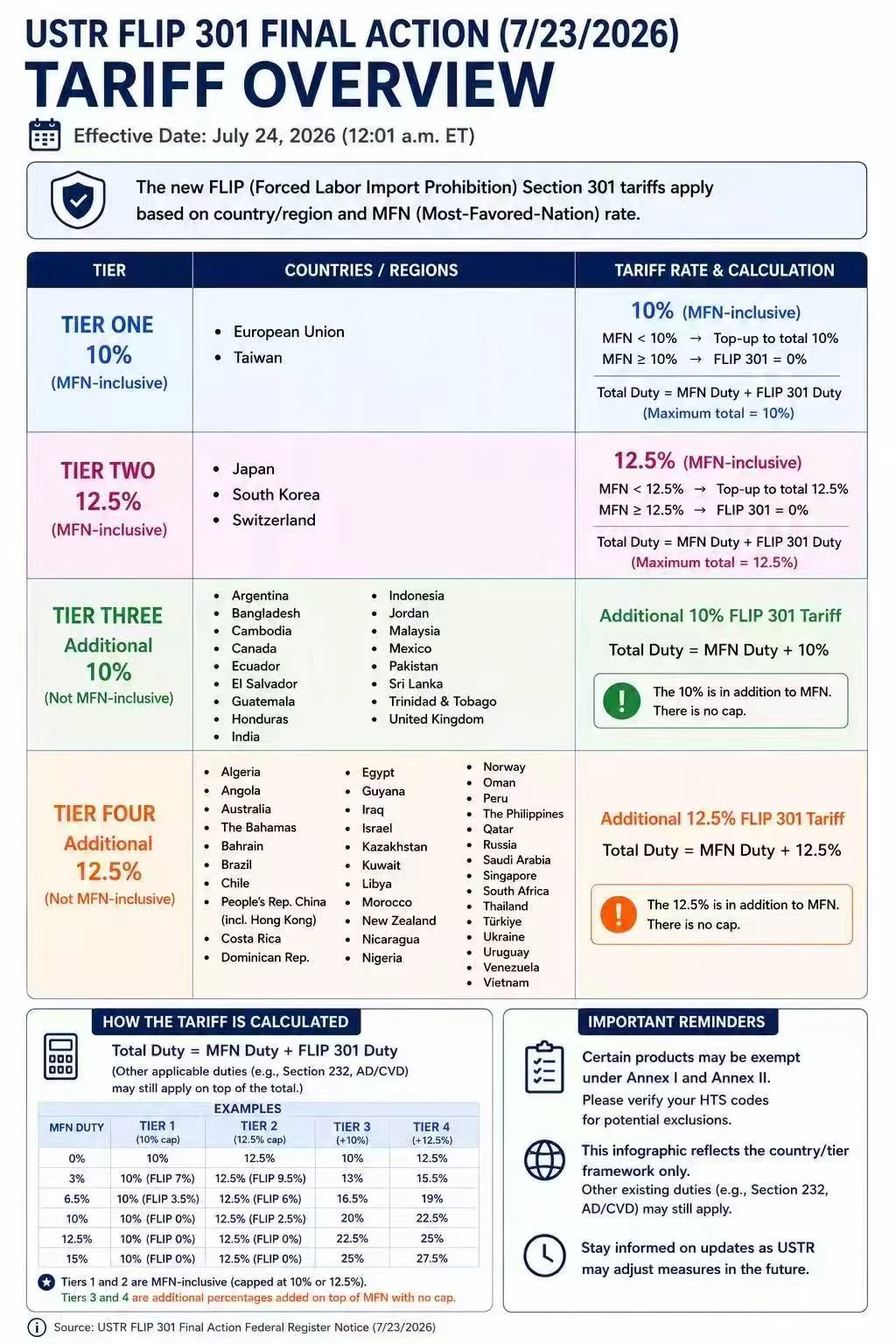
The U.S. trade policy environment has reached another major turning point. Effective July 24, 2026 (00:01 EDT), the Office of the United States Trade Representative (USTR) officially rolled out a new wave of Section 301 tariffs targeting imports from over 60 global economies. Citing concerns over international forced labor enforcement, these new measures impose additional duties ranging between 10% and 12.5%.
This action directly replaces the temporary 10% global tariff that expired on the same day, making elevated U.S. import tariffs a long-term reality. Because USTR is using Section 301 authority, the regulation bypasses recent constitutional challenges and covers over 99% of all U.S. import volume.
For shipments originating from Mainland China and Hong Kong, imports fall into the highest tier: a 12.5% flat additional tax. Crucially, this is added on top of legacy Section 301 tariffs already in place since 2018.
Here is a clear breakdown from the Chrislion Logistics customs team on how these rules work and what steps you should take to protect your supply chain.
1. Floating Cargo & Grace Period Rules
If you have containers currently on the water or arriving at U.S. ports, timing is everything right now.
The Cutoff: To avoid the new duty, cargo must have an official U.S. Customs entry date registered before July 24, 2026 (00:01 EDT).
System Delays Risk: If carrier schedules shift and your ETA automatically pushes past July 28 in the system, U.S. Customs (CBP) reserves the right to retroactively assess the additional tariff plus interest. The Importer of Record (IOR) bears full financial liability.
Customs Hold Risk: If a container arrived before the cutoff but gets flagged for physical inspection, any clearance entry completed after July 28 must be refiled under the higher duty rates.
2. Global Four-Tier Tariff Breakdown
The new framework applies different rules depending on the country of origin:
| Tier | Target Regions | How Duty Is Calculated |
| Tier 1 | UK, Canada, Mexico, India, Indonesia, Bangladesh, etc. | +10% Flat Addition: A direct 10% surtax added on top of existing base duties. |
| Tier 2 | European Union, Taiwan | 10% Minimum Floor: If existing duty is below 10%, it is topped up to 10%. If already 10% or higher, no extra charge. |
| Tier 3 | Japan, South Korea, Switzerland | 12.5% Minimum Floor: Duties below 12.5% are topped up to 12.5%. |
| Tier 4 | Mainland China, Hong Kong, Vietnam, Brazil, Thailand, Singapore, etc. | +12.5% Flat Addition: A fixed 12.5% surtax applied directly. Stacks on top of older 2018 China tariffs. |
3. Product Exemptions
Not all items are subject to the new tax. USTR explicitly excluded several essential categories:
Essential Goods: Crude oil, fuels, agricultural grains, food products, fertilizers, and basic active pharmaceutical ingredients (APIs).
Section 232 Items: Steel, aluminum, finished automobiles, and specific medical items avoid double taxation under this rule.
USMCA Goods: Products genuinely qualifying under USMCA rules of origin receive full exemption.
4. Frequently Asked Questions (Q&A)
Q: My container left Shanghai on July 20 and arrives in Los Angeles on August 3. Will I be hit with the extra 12.5%?
A: Yes. Because customs entry occurs after July 24, the shipment falls under the new rate schedule. We advise recalculating your landed costs immediately.
Q: Does this new 12.5% tariff replace the old Trump-era Section 301 tariffs on Chinese goods?
A: No. It is an additional layer. For example, if your product already carries a 25% Section 301 rate plus a 3% general rate, your new total tariff rate will be 25% + 3% + 12.5% = 40.5%.
Q: What if I move production to Southeast Asia (e.g., Vietnam or Thailand) to avoid the China rate?
A: Vietnam and Thailand are also placed under the +12.5% flat addition tier in this July update. Furthermore, U.S. Customs enforces strict "Substantial Transformation" rules-simple assembly or repackaging in a third country does not change the product's legal country of origin.
Q: How can Chrislion Help Us Navigate This Transition?
A: Our team provides pre-shipment HTS code audits, fast-track entry filing for eligible vessels, transparent landed-cost modeling, and flexible routing to make sure your shipments clear U.S. ports smoothly without unexpected fines or delays.
5. Action Items for Shippers
Audit In-Transit Cargo: Check Master Bill of Lading (MBL) sailing dates, estimated arrival times, and entry filing statuses with your forwarder immediately.
Verify HTS Classifications: Review product tariff codes against exemption lists to see if your goods qualify for energy or agricultural exclusions.
Ensure Document Accuracy: U.S. Customs inspection rates are surging. Make sure commercial invoices, purchase orders, and payment receipts align perfectly.
Re-evaluate Incoterms: Communicate with buyers or suppliers regarding cost-sharing adjustments under DDP or DAP terms.
Need Help Auditing Your U.S. Shipments or Calculating Tariff Costs?
Navigating changing trade policies requires proactive management. Whether you need an HTS code review, urgent U.S. customs clearance support, or secure ocean freight allocations, Chrislion International Logistics is here to keep your supply chain moving.
Reach out to our trade team today for a customized logistics evaluation!